FIELD REPORT // THE-FIRST-COMPLETE-SHIFT
The First Complete Shift Is Taking Shape
A July development report on the connected mission loop, five repair families, three-sector generation, physical co-op systems, and the work still ahead.
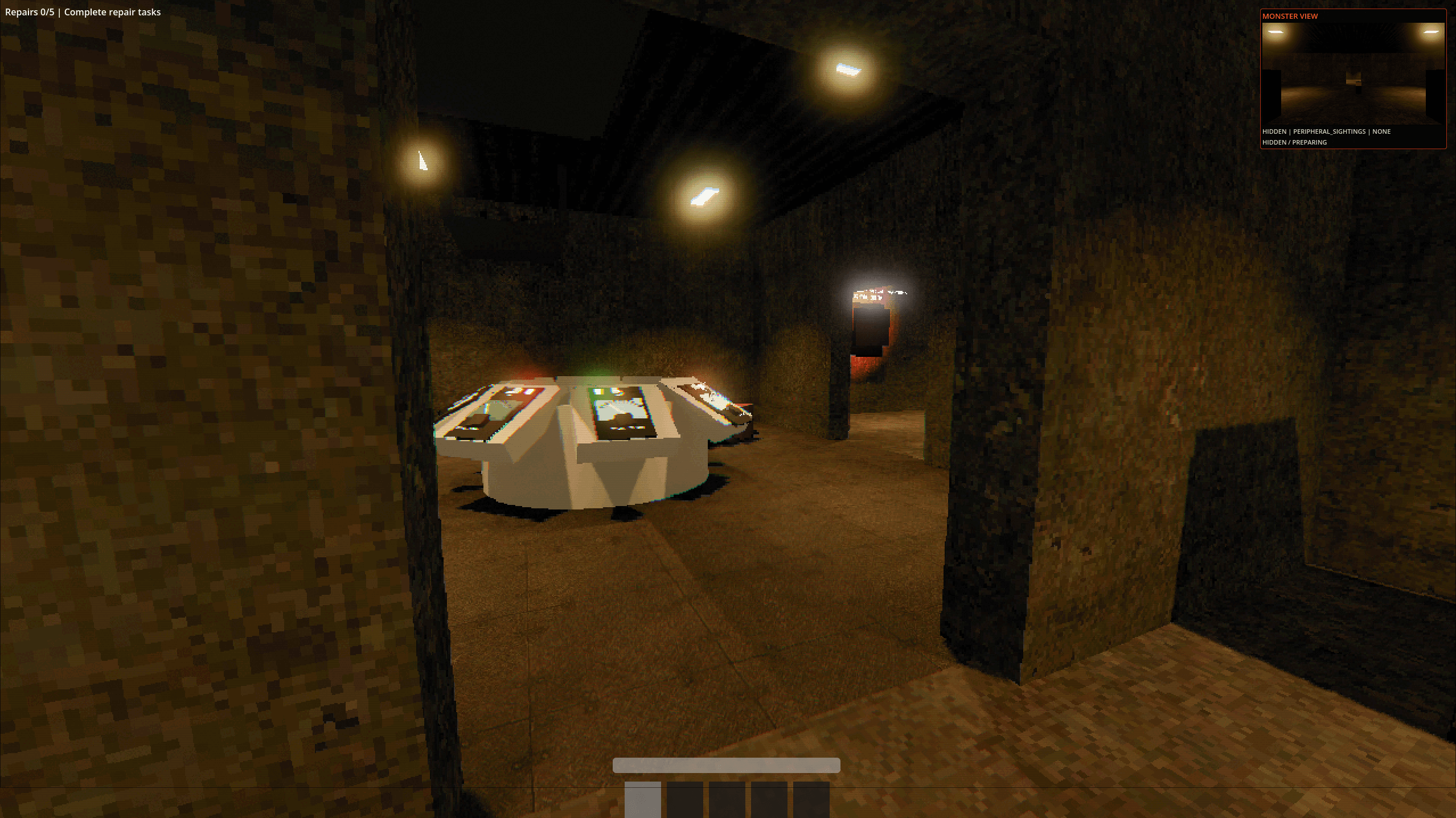
The last several weeks have been about turning a collection of strong prototypes into one repeatable shift. The game is not content-complete, but the system underneath a full floor now has a beginning, a result, and a clean way to continue.
A crew can leave the ship, enter a generated electrical facility, locate five different repair families, move the repaired grid toward extraction, resolve success or total loss, and reset for another floor. That sounds like a simple list. Making every part agree over the network—and making the result feel like one place instead of five disconnected puzzles—has been the real work.
Five jobs, one facility
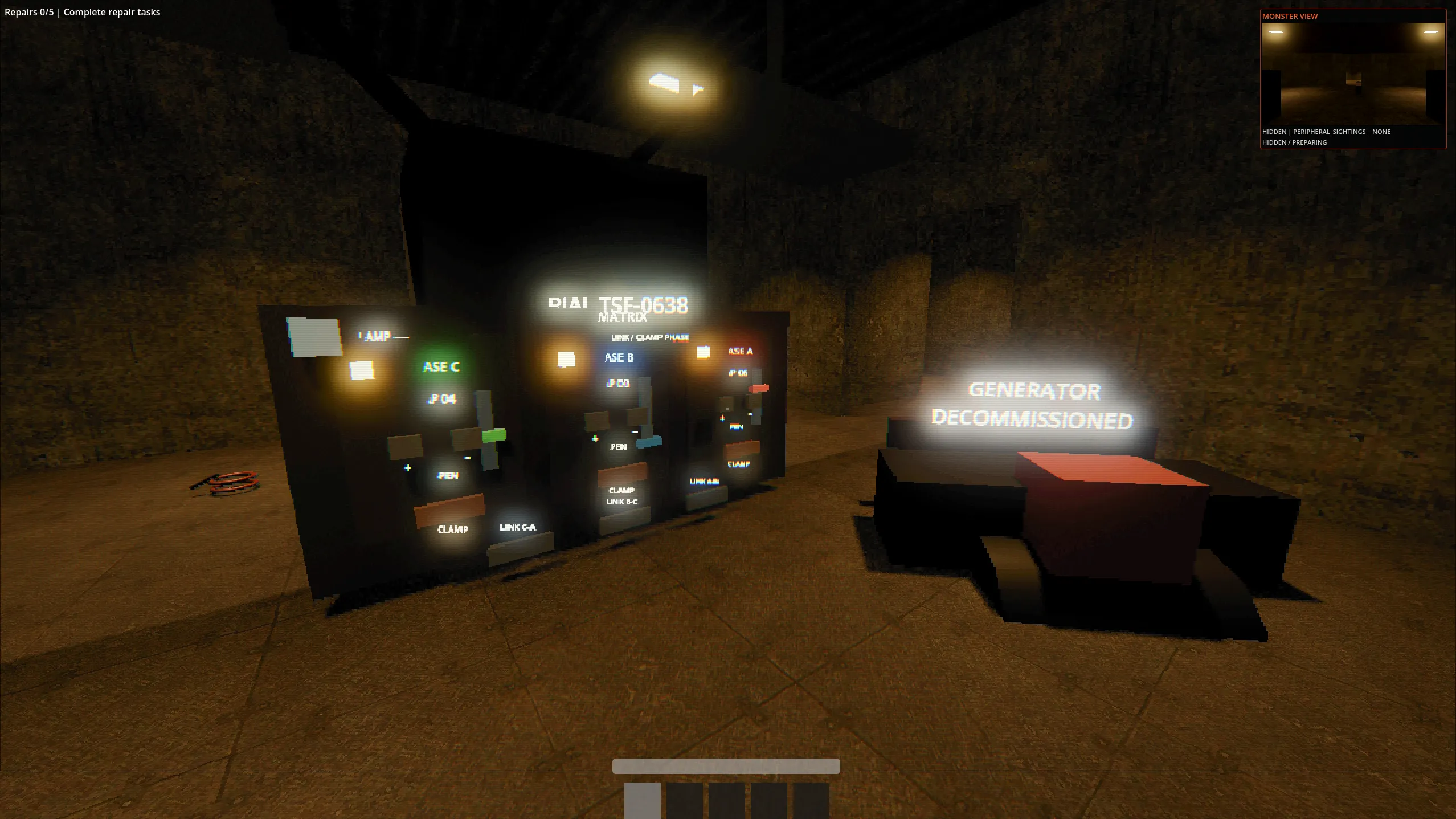
The five repair families are breaker restoration, pillar-wide switchgear routing, control calibration, battery service, and transformer phase work. Each still has its own physical procedure, identifiers, failure states, and recovery path. They now report those differences through one shared mission contract.
That means a generated machine can be found by its task ID, serial, world location, and matching maintenance-terminal procedure. Correct and incorrect inputs advance the same readable state model, completed work stays completed, and the facility work order can show the crew what remains without flattening every machine into the same checklist.
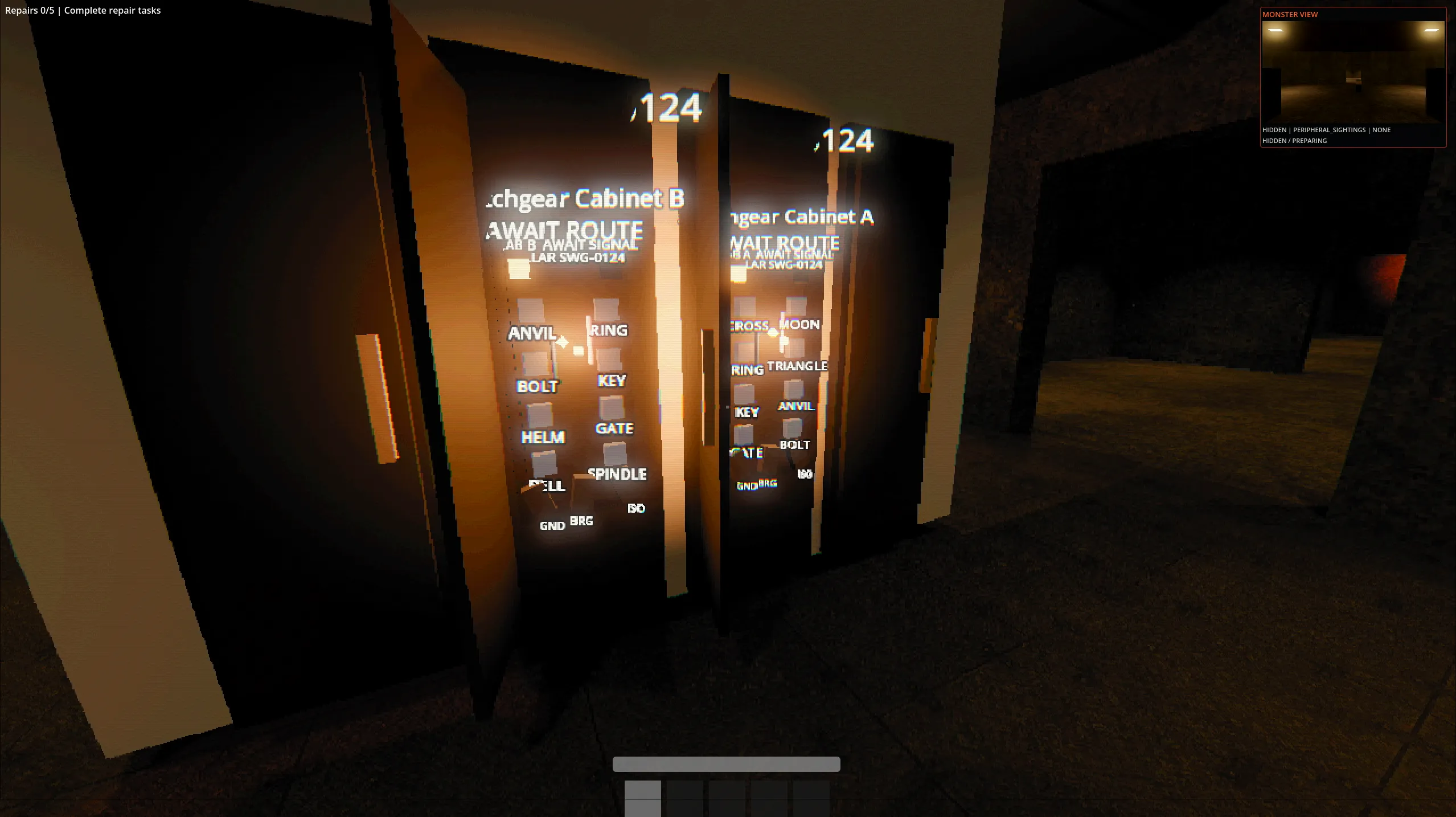
Switchgear has received the largest mechanical rework. What began as separate cabinet checklists is now a linked, pillar-wide problem with routes that cross between cabinets, misleading branches, non-adjacent identifiers, and manual labels that have to be translated carefully over voice.
A floor with structure, not just rooms
Generated facilities are now planned as three distinct sectors. Each sector grows its own mini-map around a long route, loops, short branches, a recognizable identity room, and a protected connection to the next part of the floor. Hallways match the topology they actually carry, including corners, junctions, crossing routes, and offset doorway lanes.
Current validation floors contain roughly 75–80 rooms, including 28–32 hallway pieces and longer corridor runs in every sector. Repeated generation checks verify that required repairs, sector boundaries, navigation, power, salvage, and multiplayer metadata survive the same accepted layout.
The generator also understands multiple stories. Basement, main-floor, and upper-story connections can coexist without sealing one another behind the wrong wall. Large boundary structures now sit beside smaller local landmarks, including a four-way floor breach and a tall chamber filled with hanging cable runs.
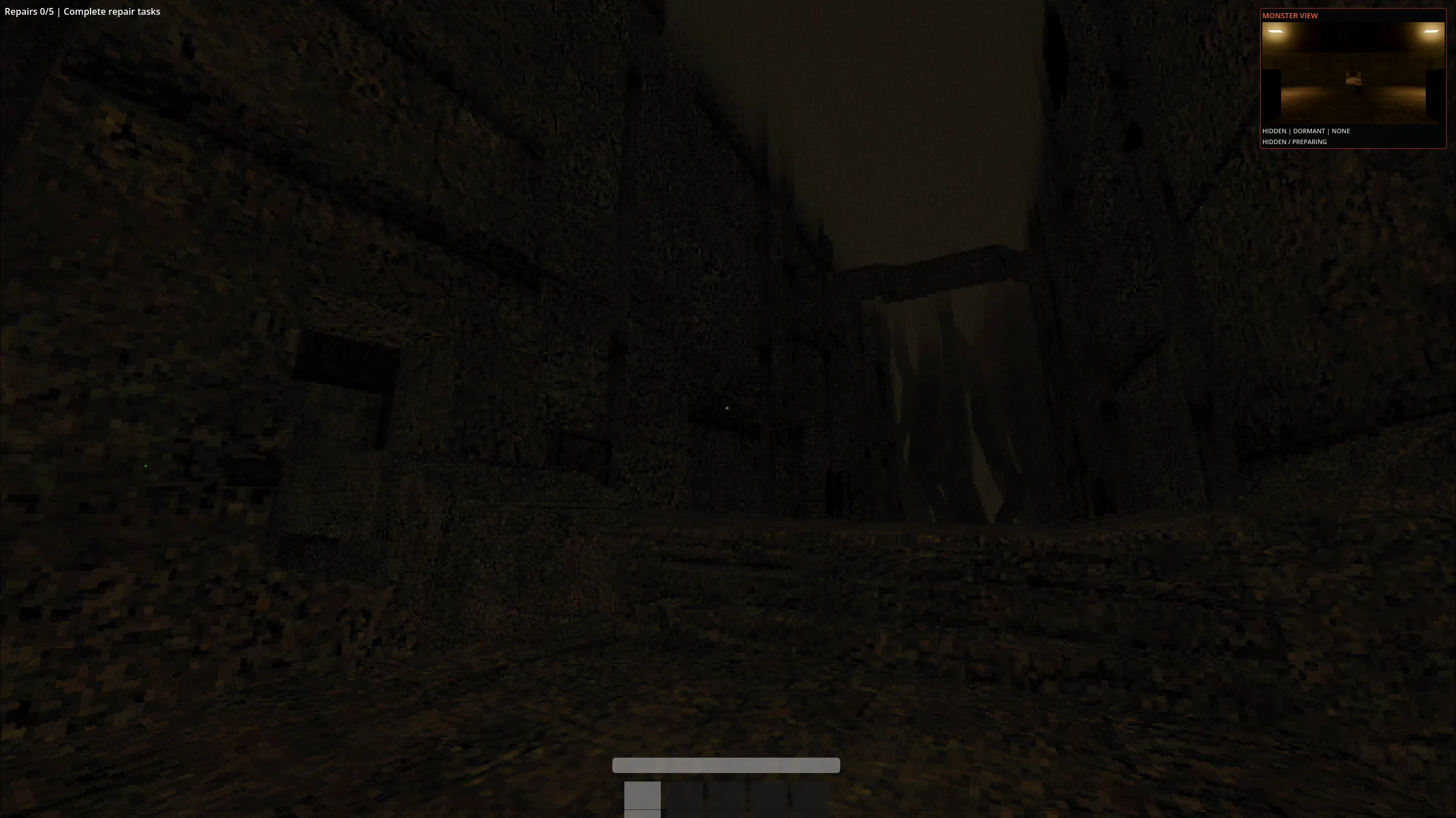
The goal is practical: players should be able to say “back through the cable room” or “past the broken crossing” and have that description mean something. Empty space remains intentional, but the route should no longer feel like a shuffled row of identical boxes.
Co-op now has physical consequences
The item system has been rebuilt around objects that can exist in a hand or in the world without maintaining duplicate versions of the same item. Ground drops are owned by the server, throws can be charged, and held equipment keeps a deliberate first-person pose before inheriting motion when released.
Impacts can interrupt interactions and force the equipped item out of a player’s hand. A downed crew member can be dragged by another player, with network ownership, obstructions, disconnects, recovery, and mission cleanup all releasing that interaction safely. These systems are still being tuned for feel, but the underlying co-op contract is working.
The mission HUD has changed with it. A facility work order now tracks the five top-level jobs, preserves repair-specific detail, and calls attention only when new work is completed.
Salvage, power, and the return trip
Repairs remain the requirement for extraction. Salvage is the optional argument layered around them.
Dead machinery contains sparse copper sources, while live circuits can offer more at the cost of the light and equipment connected to them. Sector power is authoritative across the network, and a blackout cannot quietly restore fixtures that the crew has already disabled or stripped.
Physical cargo and survivor-held tools can return to the ship. Extracted material feeds fabrication and reconstitution between missions; abandoned mission gear and equipment carried by dead crew members do not simply reappear. The campaign rules now distinguish what survived the floor from what was lost there.
The extraction sequence also has a synchronized endpoint: once the crew commits to departure, a short countdown resolves who and what is actually inside before cargo and persistent equipment are banked. The larger load-shedding climax that will connect repaired systems to the escape is still one of the next major design passes.
The Angel and the dark
The current production threat is a security machine built around the weeping-angel rule. It roams through the generated doorway graph, switches to baked navigation during pursuit, targets living players, and stops when any living crew member has an unobstructed view of it. Power-down periods give it a chance to recharge before it moves again.
Its navigation and network ownership are in place. Detection timing, audiovisual feedback, and the pressure curve still need the focused polish that turns a working rule into a memorable monster.
The surrounding presentation has reached a clearer target. Eye adaptation, restrained fog, low saturation, noise, and a fixed two-times nearest-neighbour upscale keep the facility murky and coarse without smoothing away the controls players need to read. The lighting is deliberately hostile, but it should fail through missing information—not through an unreadable image.
What comes next
The next milestone is a cohesive one-floor MVP. The system spine is there; the remaining work is about making the shift land:
- a first stylized sound pass for machinery, space, and threat;
- a fully realized Angel with readable cues and a tuned hunt;
- a brief, causal extraction climax tied to the repaired grid;
- clearer and more entertaining feedback when repair work goes wrong;
- continued room art, decoration, and landmark replacement;
- playtest tuning for two-, three-, and four-player crews.
That is the difference between “the systems can complete a mission” and “this is a shift people want to survive twice.” The next reports will stay focused on closing that gap.